
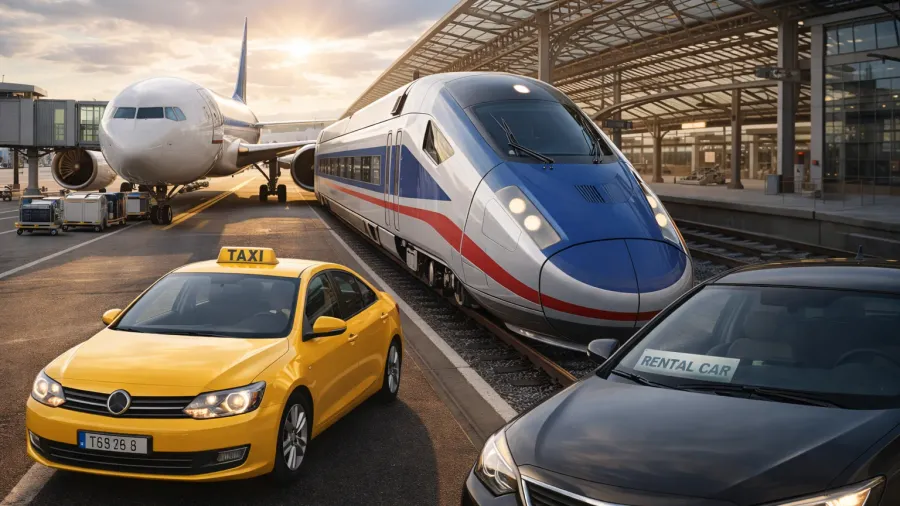
Transport is often the main source of inefficiency in a trip. By optimizing movements, you reduce transit time, costs and stress, while improving overall trip quality.
This practical guide explains common mistakes, provides a step-by-step planning method, compares transport modes, gives concrete examples and supplies a ready-to-use checklist to help you “optimiser les transports voyage” and improve your planification itinéraire.
Why transport creates inefficiency
Common errors cause wasted time and frustration:
- Too many connections or hotel changes, increasing risk of delays or lost luggage.
- Unrealistic scheduling, with impossible timing between sites.
- Ignoring geographic logic, producing inefficient back-and-forth routes.
- Underestimating urban transfer times during peak hours.
These issues lead to overloaded days, higher budgets for contingencies, and fatigue that lowers enjoyment.
Key principles to optimize transport
Time minimization vs cost minimization
You must trade off based on your priorities. Examples:
- Short trips? Prioritize time: accept a direct flight or faster train even if pricier.
- Longer trips? Favor cost savings: accept longer, cheaper routes.
Remember to include the value of time, transfer costs, and fatigue when calculating the real cost.
Reduce the number of transitions
Each hotel, station or airport change adds about 30–90 minutes of logistics. Keep accommodations to a minimum and use base locations for day trips.
Geographic logic
Group sites by area to reduce travel distance. Use a map early on to visualize clusters and avoid unnecessary routing.
Schedule optimization
- Avoid urban peak hours, typically 07:00–09:30 and 17:00–19:30.
- Avoid very early departures that sacrifice sleep quality.
- Build in buffers (15–45 minutes in city settings, 45–120 minutes for flights) to absorb delays.
Step-by-step method to optimize an itinerary
Follow this repeatable process for efficient logistics.
Step 1: map all destinations
- List each place with exact addresses.
- Pin them on Google Maps (https://www.google.com/maps) or use Rome2rio (https://www.rome2rio.com/).
- Note estimated visit durations.
Step 2: define anchor points (accommodations)
- Choose 1–3 bases depending on region size.
- Favor accommodations near major transport hubs.
- Minimize hotel changes to save time on check-in/out.
Step 3: organize the sequence of visits
- Cluster visits by proximity.
- Sequence days logically to avoid backtracking.
- Place long transfers at the end or start of days to allow recovery.
Step 4: choose transport modes
Consider door-to-door time, cost and reliability. See the comparison section for concrete thresholds.
Step 5: validate schedule feasibility
- Add buffers: +30 minutes in city, +1 hour for regional train, +1.5–2 hours for flights.
- Check frequencies and timetables on operator sites (SNCF https://www.sncf.com/, Eurostar https://www.eurostar.com/, IATA https://www.iata.org/) and on Rome2rio.
- Run a full-day simulation to spot conflicts.
Comparing transport modes
When to choose train vs plane vs car? Use these practical thresholds.
Train
- Often preferable for journeys of 0 to 3–4 hours (roughly 0–600 km depending on speed).
- Advantages: city-center to city-center, shorter boarding times, easier luggage handling, comfortable for work.
- Especially efficient in Europe. See Eurail for cross-border options: https://www.eurail.com/.
Plane
- Best for long distances or when train exceeds 4–5 hours.
- Include airport transfers, check-in and security in door-to-door time.
- Rule of thumb: choose the plane if the total door-to-door time savings exceeds 2–3 hours compared to rail. Use Skyscanner to compare flights: https://www.skyscanner.net/.
Car (rental or personal)
- Excellent for flexibility and reaching rural areas.
- Most efficient for trips > 100–150 km with multiple stops.
- Costs: fuel, tolls, parking. Check Rentalcars for price estimates: https://www.rentalcars.com/ and use Google Maps for distance/time.
Walk and bike
- For short urban trips, walking or cycling often beat taxis and public transport for door-to-door time.
- If the walk is under 20–30 minutes, it often avoids waiting and traffic.
Practical examples
Example 1: multi-city Europe trip (7 days, Paris - Brussels - Amsterdam - Berlin)
Goal: limit transfers and maximize time onsite.
Recommended plan:
- Days 1–2: Paris, base near a major station (Gare du Nord/Gare de l’Est).
- Day 3: Paris-Brussels by Eurostar (1h20), day in Brussels, overnight there.
- Days 4–5: Brussels-Amsterdam by intercity (1h50), two days in Amsterdam.
- Days 6–7: Amsterdam-Berlin (train 6–6.5h or short flight 1h15).
Why: Train links between Paris, Brussels and Amsterdam are fast and go center to center, avoiding airport time. For Amsterdam-Berlin, compare a short flight vs daytime train depending on your tolerance for airport transfers. Useful sites: Eurostar https://www.eurostar.com/, Belgian trains https://www.belgiantrain.be/, NS https://www.ns.nl/.
Example 2: road trip (7–10 days, Tuscany)
Goal: freedom and access to villages.
Recommended plan:
- Base in Florence for 2 nights. Rent a car at the station. Drive to Siena (1h15), San Gimignano (1h), and the coast (2h).
- Limit hotel changes to 2–3 to avoid losing time in check-ins.
- Cost estimate: compact car €35–70/day, fuel €1.60–2.00/l, tolls as applicable.
Why: Car grants access to rural roads and flexible pacing. Combine international train to Florence, then car rental locally.
Example 3: city base with day trips (Lisbon)
Goal: Lisbon as anchor, daily excursions.
Recommended plan:
- Base: central Lisbon for 5 nights.
- Day trips: Sintra by train (40–50 minutes), Cascais by train (30–40 minutes), Arrábida/Setúbal by car for beaches and wineries.
- Why: Short, frequent connections make a single base efficient. Check CP Portugal for schedules: https://www.cp.pt/.
Frequent mistakes to avoid
- Overpacking daily agendas. You cannot realistically do unlimited activities in one day.
- Underestimating transfer times between airports, stations and hotels.
- Ignoring luggage constraints for short connections.
- Not factoring in jet lag and cumulative fatigue.
Tools and techniques
- Maps and planning: Google Maps https://www.google.com/maps, OpenStreetMap https://www.openstreetmap.org/.
- Multi-mode comparators: Rome2rio https://www.rome2rio.com/.
- Trains: Eurail https://www.eurail.com/, SNCF https://www.sncf.com/, National Rail https://www.nationalrail.co.uk/.
- Flights: Skyscanner https://www.skyscanner.net/, IATA guidance https://www.iata.org/.
- Car rentals: Rentalcars https://www.rentalcars.com/.
- Itinerary managers: Google Sheets, Notion, or Sygic Travel https://www.sygic.com/.
How to combine them effectively:
- Map the overall route on Google Maps.
- Use Rome2rio to compare door-to-door options.
- Confirm times on operator sites, then book trains or cars.
- Keep a master itinerary with links, tickets and buffers.
Optimization checklist (printable)
- I have mapped all destinations.
- I have selected 1–3 anchor accommodations.
- I have grouped visits by geography.
- I have compared train/plane/car for each leg including door-to-door time.
- I have added buffers (city +30 min, train +1 h, flight +1.5–2 h).
- I have checked extra costs (bags, tolls, parking).
- I have minimized hotel changes.
- I have scheduled at least half a recovery day after long transfers.
FAQ
Q1. Is there a simple rule to choose train or plane?
A. If the direct train takes less than 3–4 hours, the train is often more efficient than flying because it avoids airport transfers and delivers you city-center to city-center.
Q2. How much transfer time should I allow between connections?
A. Allow at least 45–60 minutes for simple urban transfers and 90–180 minutes when switching between flights and ground transport. Check operator minimum connection times.
Q3. How can I reduce the risk of lost luggage?
A. Reduce transfers, avoid tight connections, use durable luggage tags, consider a GPS tracker for luggage and choose operators with high punctuality records.
Q4. What tools estimate door-to-door time?
A. Use Google Maps for local legs, Rome2rio for multi-modal comparisons, and operator websites for exact timetables.
Q5. How do I account for fatigue in planning?
A. Include lighter days after long transfers, allow for time-zone recovery after long-haul flights, and limit the number of major activities on travel days.
Conclusion
Optimizing travel transport is about being realistic and keeping plans simple. Map, group, anchor, compare modes with door-to-door thinking, and add buffers. With the right tools and the provided checklist, you will reduce wasted time, lower costs and travel with less stress, so you can enjoy the places you came to see.
Sources and further reading
- Google Maps. https://www.google.com/maps/
- Rome2rio. https://www.rome2rio.com/
- Eurail. https://www.eurail.com/
- Skyscanner. https://www.skyscanner.net/
- IATA. https://www.iata.org/
- SNCF. https://www.sncf.com/