
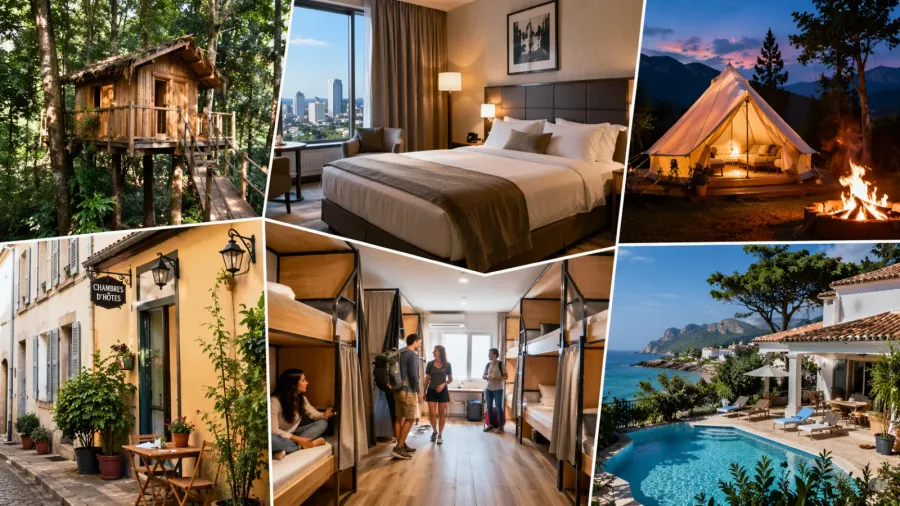
Choosing accommodation often determines the tone of a trip: budget, length of stay, travel companions and priorities (location, comfort, safety, internet) guide the decision. This guide helps weigh options — hotels, hostels, rentals, campsites and alternatives — with price benchmarks, practical advice and curated links to refine the choice.
Understand needs: budget, duration and travel companions
Clarifying the daily budget and length of stay immediately narrows options. During peak season, booking 2–3 months ahead is common, while off‑peak stays can be booked 2–30 days before. For short trips (1–4 nights), location and cancellation flexibility matter most; for multi‑week stays, kitchen facilities and storage are priorities. Families typically prefer connecting rooms or apartments, solo travelers may opt for hostels to socialize, and digital nomads prioritize reliable Wi‑Fi and workspace. For broader planning resources, Lonely Planet provides in‑depth destination guidance: LonelyPlanet.
Classic options and their strengths
Hotels: standardization and comfort, but regional variability
Hotels remain the most universal option. Their main advantage is predictability: reception, housekeeping, security, sometimes breakfast and concierge services.
In Western Europe, a 3-star hotel typically ranges from €80 to €150 per night. The same level of comfort is often cheaper in Eastern Europe (€40–90) and significantly cheaper in Southeast Asia (€20–70). In contrast, prices are higher in the United States and Japan, often for smaller room sizes.
The key advantage is simplicity, making hotels ideal for short stays, business trips, or travelers who want minimal friction. However, value for money can be poor in major cities (Paris, New York, Tokyo), and the experience tends to be standardized, sometimes lacking local character.
Tip: In Asia, independent hotels often provide better service and value than international chains.
Hostels: social and budget-friendly, but variable comfort
Hostels are highly competitive on price, especially in Europe and Asia. In Western Europe, dorm beds range from €15 to €50, while in Southeast Asia they can drop to €5–15. Private rooms are often 20–40% cheaper than equivalent hotel rooms.
Their main strength is social interaction: meeting other travelers, shared activities, and a relaxed atmosphere. This suits solo travelers, backpackers, or flexible trips.
However, comfort varies widely: noise, shared spaces, and inconsistent standards. In regions like Eastern Europe and Latin America, quality can be excellent but uneven.
Tip: Look for modern “boutique hostels,” especially in Asia or Eastern Europe, which often approach hotel-level comfort at lower prices.
Vacation rentals: space and autonomy, but fewer services
Apartments are particularly suitable for multi-day stays or group travel. They provide a kitchen, more space, and often a more local experience.
In Europe, a one-bedroom apartment in a city center typically costs €80–180 per night, but becomes cost-effective for two or more people. In Asia, prices are lower (€30–100), while in the United States they tend to be higher and include additional fees.
Advantages: autonomy, space, cost efficiency for groups. Disadvantages: less flexible check-in, cleaning fees, and inconsistent quality.
Tip: Weekly bookings often reduce the nightly rate significantly. Also check local regulations (e.g., restrictions in Paris or New York).
Camping: economical and immersive, but weather-dependent
Camping remains one of the most affordable options in many regions, typically €10–40 per night in Europe and North America. However, in countries like Japan or Australia, well-equipped campsites can be more expensive.
It is well suited for nature-oriented travelers, road trips, or long stays. In countries such as Norway or Canada, wild camping is sometimes allowed, reducing costs further.
Limitations: weather dependency, lower comfort, and need for equipment.
Tip: Use national park passes (e.g., in the U.S.) or local apps to find free or low-cost sites.
Alternative accommodations: balance between authenticity and comfort
This category includes guesthouses, B&Bs, gîtes, ryokan in Japan, riads in Morocco, and aparthotels.
Prices vary widely by region:
Europe: €60–150 for a guesthouse Japan (ryokan): €100–300 including meals Morocco (riad): €40–120 with strong value for money
Advantages: local experience, charm, often better hospitality. Disadvantages: less standardized, sometimes less flexible.
Tip: In countries like Japan or Morocco, these options often deliver better overall value and experience than standard hotels.
Match accommodation to travel style
For families, space and safety matter most: look for properties with kitchens, laundry and age‑appropriate sleeping arrangements. Business travelers and digital nomads should prioritize internet speeds (aim for 50–100 Mbps for heavy use), workspace availability and flexible monthly billing for extended stays; specialized platforms and local coworking directories can help. Luxury seekers will focus on 4–5 star hotels, where nightly rates often start from $150–$300 depending on the destination, while adventure travelers will favor proximity to activities and flexible cancellation. When deciding, consult up‑to‑date reviews and recent traveler photos: Tripadvisor provides a large volume of user feedback.
Booking and preparation: strategies and safeguards
Compare cancellation policies, consider travel insurance and watch for hidden fees. Non‑refundable rates can be 10–30% cheaper, but flexible options often cost more. For long stays, negotiating monthly discounts can cut costs by 10–30%. Before booking, verify recent reviews, deposit rules and cleaning fees. Official travel advisories and safety tips from government sources, such as the U.S. Department of State, give practical pre‑departure guidance.
Practical tips for arrival and the stay
Pay attention to check‑in and check‑out times; many places require check‑out by 11:00–12:00 and check‑in after 14:00–15:00. Notify hosts of late arrivals to avoid issues. Evaluate distance to public transport and attractions — 10–30 minutes of daily transit can affect the itinerary. Confirm accepted payment methods and keep a reservation copy. For safety and hygiene concerns, read specific recent comments on noise and nighttime safety and, if necessary, contact the property’s front desk or the booking platform’s customer service.
Conclusion
The right accommodation balances budget, duration, comfort and priorities. By using price benchmarks, reading recent reviews, checking cancellation terms and keeping some flexibility, it is possible to optimize value and enjoy a smoother trip experience.
FAQ
What is the most economical accommodation for a week‑long trip?
Hostels (dorms) and campsites are generally the cheapest options for a week, with dorm beds and pitches typically far below hotel rates; shared rentals can also be economical for groups.
When is the best time to book to get fair prices?
Booking 2–3 months ahead for peak season is recommended; very popular destinations may require 3–6 months. Off‑season travel can benefit from last‑minute deals.
Rental or hotel: which is better for a family?
A rental with a kitchen and separate spaces usually offers more comfort and flexibility for families and can be cost‑effective compared with multiple hotel rooms.
How to judge if an online listing is trustworthy?
Check multiple recent reviews, verify host or property identity, and use reputable platforms with customer support and booking protections.
Is travel insurance always necessary?
Insurance is strongly advised for international travel: it covers trip cancellations, medical expenses and other incidents. Review coverage limits and exclusions before purchasing.